

October 28, 2026
CHOCOLATE
This year, Americans are expected to spend over $4 billion on Halloween candy, and most of that candy will be chocolate. Based on 2025 sales analyzed by Instacart, seven of the top ten candies purchased for Halloween in the United States were chocolate. Chocolate has become synonymous with holidays, celebrations, and gifts. But chocolate candy is a relatively recent invention, and the origin of its popularity owes more to its packaging than its taste.
When Spanish explorers first encountered Mesoamerican civilizations in the 1500s, they were met with a strange, frothy, chocolate drink made from roasted cocoa beans, vanilla, chili peppers, and other spices. The drink held particular political and spiritual significance for native cultures, but the Europeans viewed it as a delectable for the wealthy. They returned with the unique beans, and the hot chocolate beverage rapidly spread throughout European aristocracies.
In England, several confectioners began offering processed cocoa beans with their other sweets, most notably J.S. Fry & Sons and Cadbury. J.S. Fry & Sons was founded as a confectionery in 1761 that also processed cocoa beans for chocolate drinks. Cadbury began selling the same products in 1824. After the Dutch invention of the cocoa press in 1828, Fry created the first chocolate bar as a standalone treat in 1847, and that changed the entire chocolate industry forever. The new sweet treat became extremely popular.
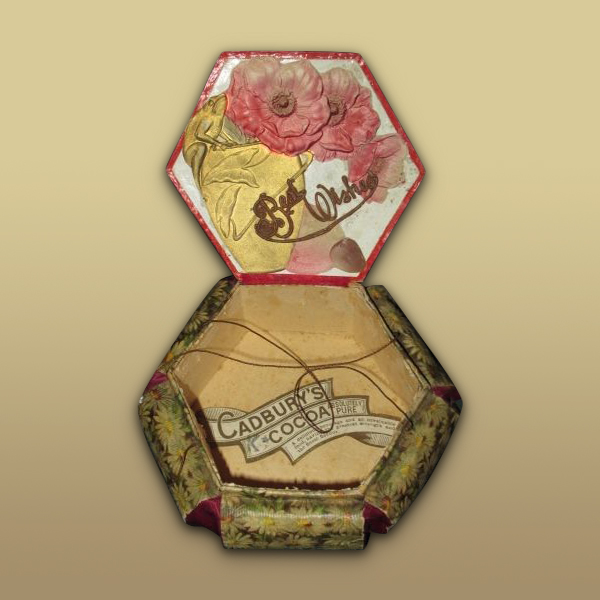
Cadbury chocolate box, circa 1890. Photo by Susan Voake.
In 1861, Richard Cadbury and his brother George took over the family business, which was on the brink of bankruptcy. Richard decided that the best way to save the company was through marketing, and his greatest marketing idea came in early 1868. In preparation for Valentine's Day, Richard conceived of an ornate package filled with assorted chocolates that would make a unique gift for the holiday. Described as a "Fancy Box," the package was decorated with Richard's own paintings, and was an immediate hit. Five years later, Fry invented the first chocolate Easter egg. Cadbury followed suit in 1875 when it released the first Cadbury Easter Egg, which would become the holiday tradition known as Cadbury Creme Eggs in 1971.
By 1910, Cadbury had been transformed from a business on the brink of collapse to the number one chocolate company in England, and eventually acquired J.S. Fry & Sons in 1919. In 2010, Kraft purchased Cadbury for $19.5 billion in a hostile takeover, demonstrating just how valuable the chocolate market had become. The next year, facing increased criticism from investors, Kraft split into two companies, creating Mondelez International to house all global snack brands, including Cadbury. Last year, Mondelez International reported revenues over $38 billion.
In 2025, the global chocolate market was worth almost $117 billion dollars, driven primarily by seasonal and personalized gifting. Chocolate's popularity persists because it has become so deeply connected with holidays, special events, personalized gifts, and custom packaging. That makes sense, because those were the exact same drivers that created chocolate as a premium gift product in the first place.
SOURCES
- "NRF Halloween Survey Shows Consumer Spending Expected to Reach $13.5 Billion" from National Retail Federation
- "This Is America's Most Popular Halloween Candy, According to a New Report" from Food & Wine
- "How Did Quakers Conquer the British Sweet Shop?" from BBC
- "Chocolate's Sweet History: From Elite Treat to Food for the Masses" from History
- "Earliest Box of Valentine's Day Chocolates" from Guinness World Records
- "How a Victorian-era Marketing Ploy Made Chocolate the Ultimate Valentine's Day Gift" from Northeastern Global News
- "Cadbury and Kraft: A Bittersweet Moment Case Overview" from Academia.edu
- "The History of Cadbury’s Chocolate: Britain's Sweet History Unwrapped" from Discover Britain
- "Chocolate Market Size, Share, and Growth Forecast, 2025 - 2032" from Persistence Market Research
- Revenue data from Mondelez International annual reports



